Abstract
Keycloak is an open-source identity and access management platform that provides authentication, authorization, single sign-on (SSO), identity federation, user management, and token-based security services for applications and APIs. It enables organisations to centralise identity functions while supporting standards such as OpenID Connect, OAuth 2.0, and SAML.
Keycloak gives engineering teams deep control over identity infrastructure. That control is one of its greatest strengths, but in regulated environments it can also become a governance risk. Console-based changes, manual realm updates, undocumented client configuration, and inconsistent promotion across environments can create configuration drift and weak auditability.
In production, the most serious Keycloak risk is not always authentication failure. It is uncontrolled change. A realm setting changed directly in the admin console, a client updated without review, or an authentication flow modified outside the delivery pipeline can leave teams unable to prove what changed, why it changed, who approved it, and how to restore the intended state.
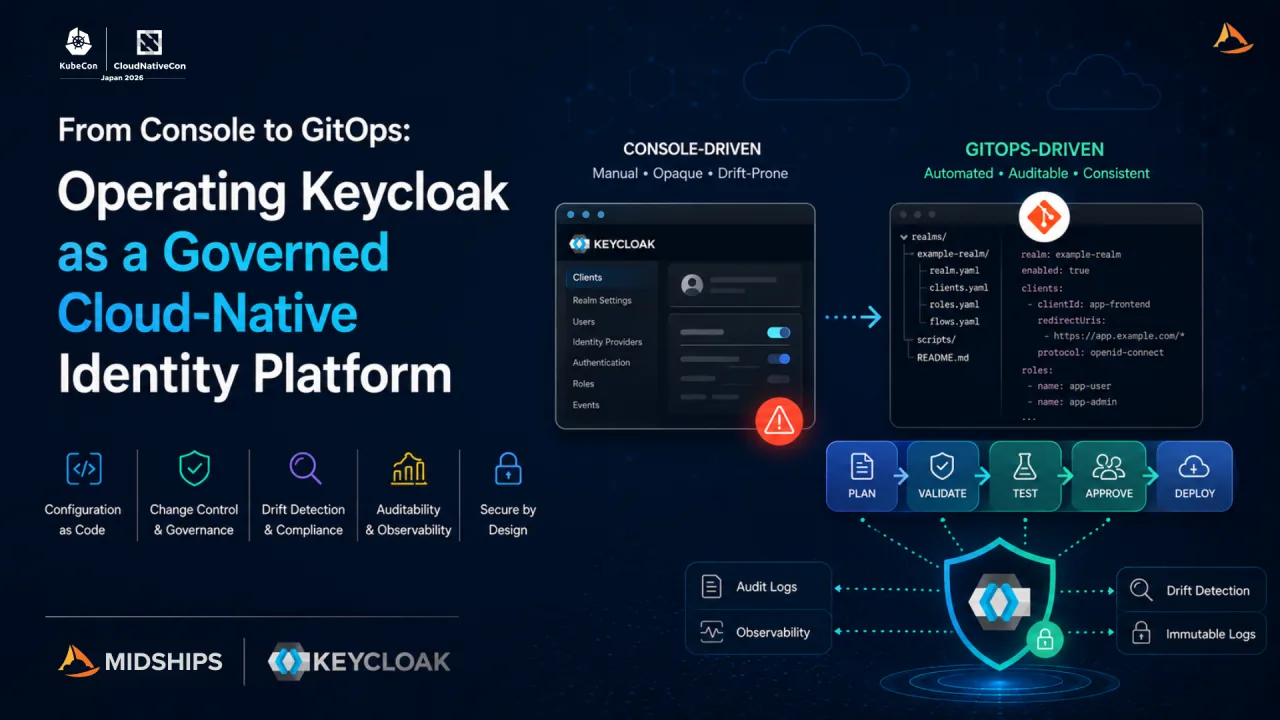
This paper presents an operating model for Keycloak as a governed cloud-native identity platform. It focuses on configuration-as-code through the Keycloak REST API, CI/CD-driven change control, drift detection, OpenTelemetry-based audit pipelines, immutable logs, and controlled break-glass access. The goal is to operate Keycloak as a disciplined platform service rather than a manually administered identity server.
1. The hidden risk: configuration drift
Configuration drift is the divergence between what was approved, what is documented, and what is actually running. In identity infrastructure, drift is especially dangerous because small configuration changes can affect authentication, authorisation, client access, federation behaviour, and user journeys.
Keycloak’s default operating model can encourage drift. The admin console allows interactive changes to realm settings, client registrations, authentication flows, identity provider mappings, user federation configuration, and role definitions. This is useful during development, but it becomes risky when the same pattern reaches production.
A console change may appear harmless. An engineer updates a client setting, adjusts a redirect URI, modifies a role, or changes an authentication flow. The system may continue working. But unless the change is captured in a version-controlled source of truth, reviewed, approved, tested, and promoted through a defined process, the running system has diverged from the approved state.
Over time, this makes the identity platform harder to operate. Teams lose confidence that lower environments match production. Recovery becomes manual. Audit evidence becomes incomplete. A later incident may require teams to reconstruct configuration history from logs, tickets, and memory.
For a governed platform, this is not sustainable. The intended state of Keycloak must be explicit, versioned, reviewable, and reproducible.
2. Why console-first administration does not scale
The Keycloak admin console is valuable for exploration, development, and troubleshooting. In production, however, it is a weak foundation for regulated change management.
A console-based change can show that something happened, but it does not naturally provide the full context required for governance. It does not show which pull request introduced the change, who reviewed it, which approval gate was satisfied, what automated validation ran, or how the change can be rolled back to a known-good state.
This is the gap between logging an event and governing a change. K
eycloak can produce event logs for user activity, token issuance, and realm configuration changes. Those logs are useful, but they do not by themselves provide the full compliance context of an administrative action. In a regulated operating model, teams need to connect the change to the delivery process: the author, reviewer, approval record, test result, deployment execution, and timestamp.
Console-first administration also weakens environment consistency. If changes are made manually in development, staging, and production, each environment can slowly become unique. Once this happens, promotion becomes unreliable. A configuration that works in one environment may fail in another because the actual running states are no longer aligned.
The production model should therefore avoid treating the console as the normal path for change. Keycloak configuration should move through the same controlled delivery process as the rest of the platform.
3. Keycloak as a headless service
The strongest governance pattern is to operate Keycloak as a headless, API-driven service from day one.
In this model, the admin console is not exposed on production or non-production networks. All configuration is applied through the Keycloak REST API, driven by a deployment pipeline. The pipeline becomes the only authorised path for configuration change.
This is a simple principle, but it has significant operational consequences. Realm settings, client definitions, authentication flows, identity provider mappings, user federation configuration, and role definitions are no longer changed by logging into a browser UI. They are changed through code, review, and automated deployment.
The effect is to make governance technical rather than procedural. A console that exists but is restricted by policy is weaker than a console that is not available on the production network. In the headless model, teams do not rely only on people remembering the process. The platform enforces the process.
This changes how teams work. Engineers need tooling, scripts, templates, and configuration schemas that replace the console as the normal working environment. The investment is worthwhile because the result is a platform that is easier to audit, compare, promote, and recover.
4. Configuration-as-code through the REST API
In a governed Keycloak deployment, the configuration repository becomes the source of truth. It should describe the intended state of the identity platform across environments.
This includes realm configuration, clients, authentication flows, identity provider mappings, user federation settings, and roles. Changes are proposed as pull requests, reviewed, approved, and then applied through a deployment pipeline using the Keycloak REST API.
This approach gives the platform several important properties.
Every configuration change has a Git commit with an author, timestamp, and reviewer. This gives teams a durable change history that is separate from the running system.
The pipeline can perform pre-flight validation before changes reach production. It can catch constraint violations, undefined references, and schema errors before they become runtime issues.
Recovery becomes predictable. If a configuration is corrupted or a change causes unexpected behaviour, restoration can be performed by re-executing the pipeline against a known-good repository state. The team does not need to manually reconstruct what the configuration should have been.
The same principle applies to deployment configuration. Helm values files should be stored alongside realm configuration so that application version, infrastructure configuration, and identity configuration can be reconstructed from a single repository state.
5. Drift detection as a scheduled control
Configuration-as-code is not complete unless the running system is checked against the intended state.
A scheduled drift detection job should compare the live Keycloak configuration with the repository-defined configuration. If the two differ, the platform should raise an alert or trigger the appropriate response process.
This matters because drift can still occur through emergency access, failed deployments, partial rollbacks, or manual intervention. Without drift detection, the team may not know that production has diverged until an incident or audit request exposes the difference.
Drift detection turns configuration integrity into an active platform control. Instead of asking teams to manually confirm that production matches the repository, the platform checks continuously and produces evidence when it does not.
6. Audit pipelines and immutable logs
Keycloak event logs are necessary but not sufficient for regulated operations.
By default, Keycloak can write events to the database and expose them through the admin API. This is useful, but it does not solve long-term audit requirements on its own. Database event storage is bounded, and regulated environments may require long retention periods for some event categories.
The stronger pattern is to consume Keycloak event logs through an OpenTelemetry pipeline and forward them to an immutable log management system. This separates audit retention from the operational database and makes the event stream available for compliance queries.
However, event logs still need context. A Keycloak event may show that a configuration object changed, but the CI/CD system provides the surrounding governance record: pull request, approver, automated validation, deployment execution, and timestamp.
Together, these two records create a stronger audit trail. Keycloak provides the platform event. The delivery pipeline provides the change-management context. The immutable logging system provides retention and queryability.
7. Break-glass access as a controlled exception
Some deployments may retain emergency console access. If they do, it should be treated like direct production database access.
Access should be limited to named individuals. It should be time-bound through a privileged access management process. Sessions should be recorded. Access events should be logged to the immutable audit trail. The path should exist only for exceptional situations, not routine administration.
Break-glass access must also be tested. It is not enough to know that emergency credentials exist. The full process should be exercised: credential retrieval, access approval, console login, session recording, and audit capture.
An emergency path that has not been tested may fail when it is needed most. In a governed operating model, break-glass access is not a shortcut around controls. It is a controlled exception with its own evidence trail.
8. Operating model for governed identity
A governed Keycloak platform requires clear ownership.
Application teams should request identity changes through code, not through direct console edits. Platform teams should own the templates, pipelines, deployment process, and drift detection controls. Security teams should define guardrails for privileged access, authentication flows, client patterns, and audit expectations. Compliance teams should be able to consume evidence from the repository, CI/CD system, Keycloak events, and immutable logging platform.
This model changes Keycloak from a manually administered system into a platform service. Teams can still move quickly, but changes happen through a controlled path. The repository defines intent. The pipeline applies intent. Drift detection verifies intent. Audit pipelines preserve evidence.
Conclusion
Keycloak’s flexibility is a strength, but without governance it can become a source of operational and compliance risk. The admin console makes configuration easy to change, but production identity infrastructure needs more than easy change. It needs controlled, reviewable, reversible, and auditable change.
The most effective pattern is to operate Keycloak as a headless, API-driven service. Configuration should live in a repository, move through pull requests, pass through validation, and be applied through CI/CD. The running system should be checked for drift. Events should flow through OpenTelemetry into immutable logs. Break-glass access, if retained, should be tightly controlled and tested.
The result is a Keycloak platform that can be operated with the same discipline as other critical cloud-native infrastructure: versioned, automated, observable, auditable, and recoverable.
Writer’s Overview
Ajit Gupta – Co-Founder & CEO, Midships
Ajit leads Midships Group’s transition from a specialist identity consultancy to a portfolio of autonomous, AI-native business units. He focuses on long-term business relevance through platform thinking, customer outcomes, and scalable operating models.
Short bio: Ajit is a strategic founder with deep expertise in IAM, platform delivery, and AI services, driving Midships’ expansion across Asia, the Middle East, and beyond.