

Abstract
Production identity failures do not always begin with infrastructure outages. Many begin with early token and session design decisions that become difficult to reverse later. Long-lived access tokens, introspection-heavy service designs, weak revocation paths, and inconsistent session binding can create security and availability risks that only become visible after applications have already integrated with the identity platform.
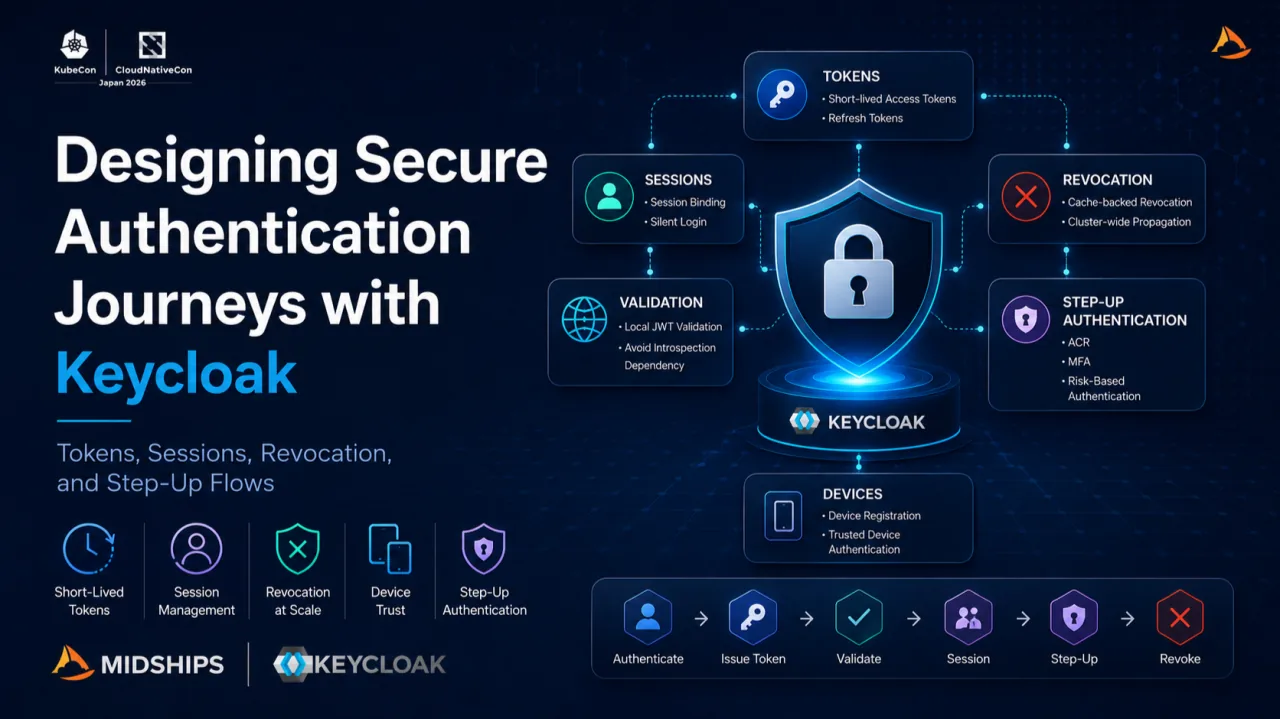
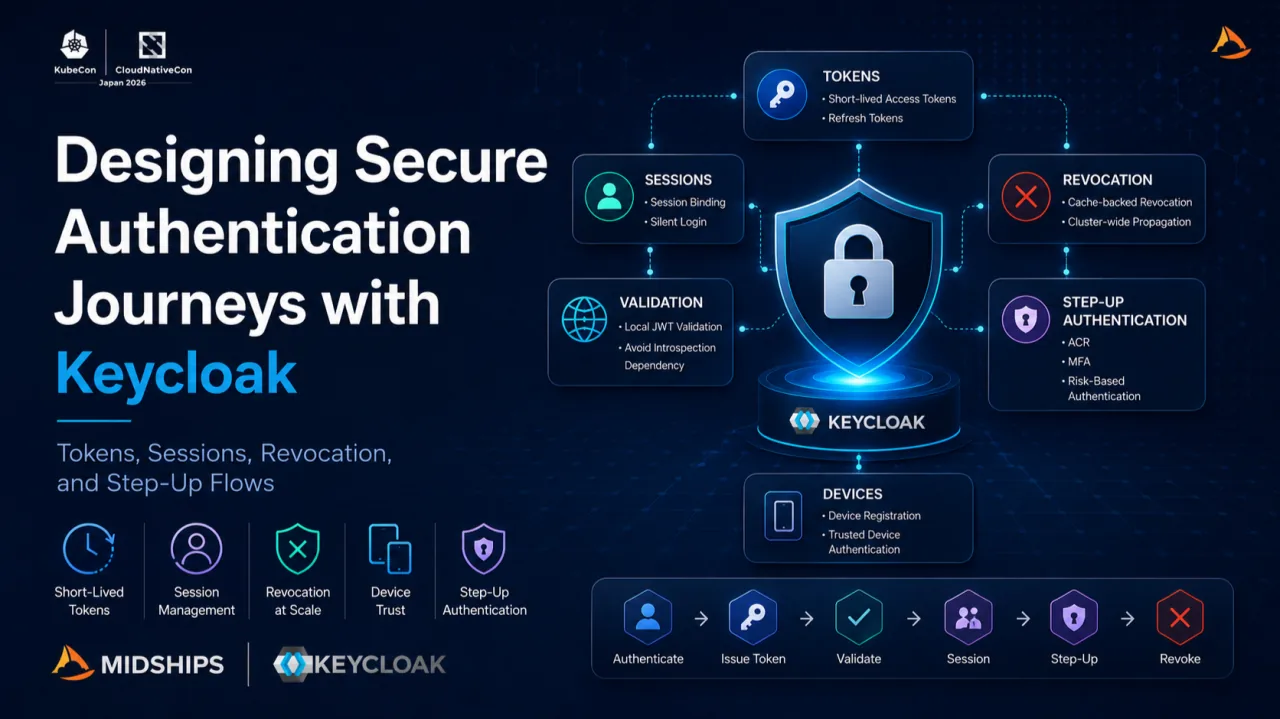
Keycloak can support secure authentication journeys, but the architecture must be deliberate. Token lifetime, local validation, session binding, revocation, device registration, silent login, and step-up authentication all affect downstream services, user experience, and operational reliability.
This paper explains the Keycloak-backed authentication and session patterns that should be decided before production dependency forms. It focuses on short-lived access tokens, refresh token trade-offs, JWT local validation, cache-backed revocation, session binding, device registration, silent device login, step-up authentication through Authentication Context Class References, and resilient enrolment journeys.
1. Why token design must come early
Session management at scale begins with token design. The decisions made before the first user authenticates will shape how every downstream service interacts with Keycloak.
One of the hardest decisions to reverse is token lifetime. If services are built around long-lived access tokens, shortening those lifetimes later becomes disruptive. Downstream services may have already assumed that tokens remain valid for a long period. Operational processes may also be built around that assumption.
The production pattern described in the source paper is to use short-lived access tokens, such as five-minute access tokens, with longer refresh token windows, such as eight hours. This reduces the blast radius of token compromise while preserving a usable session experience.
However, this design has an operational cost. Shorter access tokens increase refresh activity. That additional refresh volume must be sized into the Keycloak deployment and the cache tier. Teams that use long access token lifetimes only to reduce cache pressure may later regret the decision when a token compromise incident requires session invalidation.
The lesson is simple: token lifetime is not only a security setting. It is also an infrastructure and service design decision.
2. Short-lived tokens and refresh token trade-offs
Short-lived access tokens reduce the period during which a compromised token can be used. This is especially important in environments where authentication is part of a larger regulated or high-value transaction system.
Longer refresh token windows support user experience. Users can continue their session without repeatedly authenticating, while access tokens remain short enough to limit exposure.
This balance creates two engineering requirements.
First, the refresh path must be reliable. If many services and users depend on frequent refresh operations, the cache tier and Keycloak deployment must be sized for that traffic.
Second, session invalidation must be practical. In a fraud event, account closure, credential reset, or regulatory hold, teams may need to terminate active sessions promptly. If access tokens live too long, the system may continue accepting them longer than the business or compliance process allows.
Token lifetime therefore should be treated as a production design decision, not as a default value left unchanged until an incident forces review.
3. Local validation versus token introspection
Another early decision is whether downstream services validate tokens locally or call Keycloak for token introspection.
Services that validate tokens by calling the Keycloak introspection endpoint create a direct dependency on Keycloak availability. If Keycloak is unavailable or slow, those services may also become unavailable or slow, even if they are otherwise healthy.
Services that validate JWTs locally can tolerate Keycloak unavailability for the duration of the token lifetime. They can continue serving requests based on locally verifiable token data until the token expires.
For environments where Keycloak is not the only component with an availability requirement, local validation is usually the stronger default. It reduces runtime coupling between application services and the identity platform.
This does not remove the need for careful token lifetime design. Local validation works best when access tokens are short-lived, because the system is intentionally accepting that a token may remain valid until expiry. The shorter the token lifetime, the smaller the compromise window.
The broader principle is to avoid making every request dependent on a live call to the identity platform unless that dependency is truly required.
4. Revocation as a production capability
Session termination is not an edge case. It is a core production requirement.
Regulated institutions may need to invalidate sessions because of account closure, fraud events, regulatory holds, password resets, account locks, or device unbinding. In a small single-cluster deployment, this can be straightforward. At scale, it becomes more complex because revocation must propagate reliably across the environment.
The pattern described in the source paper is to maintain a revocation list in the cache tier with a time-to-live equal to the maximum token lifetime. All session validation checks the revocation list. Revocation events are propagated to all cluster members within the cache replication latency window.
This design creates an important operational obligation: the revocation path must be tested as part of every deployment.
A revocation flow that works in staging but fails silently in production because of a misconfigured cache endpoint or certificate mismatch is not just an operational failure. In a regulated environment, it can become a compliance event.
Revocation should therefore be treated like a first-class production capability. It needs architecture, monitoring, deployment testing, and failure handling.
5. Session binding and hijacking risk
Session binding reduces the risk of session hijacking by associating a session with specific context, such as a device or IP range. This can improve security, especially in high-value user journeys.
However, the policy must be designed before implementation. Binding sessions too tightly can break legitimate usage. Corporate users may access services through shared network egress points or proxies. Customers may use multiple devices. Network conditions may change during a valid session.
The source paper highlights session binding as one of the token and session design decisions that cannot easily be reversed. Once downstream systems and user journeys are built around a particular session policy, changing it later can affect both security behavior and user experience.
The right approach is to decide the policy first, then implement it consistently. The system should be clear about when a session remains valid, when re-authentication is required, and which context changes are considered suspicious.
6. Device registration and silent device login
Financial-style authentication journeys often require patterns beyond standard username-and-password login. Device registration and device binding are two of the most important examples.
Binding authentication to a registered device, rather than only to a credential, can reduce account takeover risk in high-value contexts. A device registration flow requires a secure device handshake, storage of a device-specific credential, and a step-up flow for adding new devices from a trusted context.
Silent device login is also common in mobile banking-style experiences. It allows a bound device credential to authenticate without direct user interaction, improving user experience.
But silent login must be carefully controlled. It should not remain possible after a device unbinding event, password reset, or account lock. If the trust relationship with the device is removed or the account state changes, the silent login path must stop working.
This again connects session design with revocation. Device unbinding and account state changes must invalidate the right sessions and prevent the wrong authentication paths from continuing.
7. Step-up authentication with ACR
Some actions require stronger authentication than ordinary login. High-value transactions are a common example. The source paper refers specifically to regulatory requirements such as PSD2 and equivalents in other jurisdictions, where step-up authentication is required for high-value transactions.
Keycloak can support this through Authentication Context Class References, or ACR. ACR allows authentication flows to represent different assurance levels.
However, Keycloak does not automatically know the business risk of a transaction. The mapping between transaction risk and authentication requirement must be designed explicitly. For example, a high-value action may require a stronger authentication context than a low-risk account view.
The important point is that step-up authentication is not only a Keycloak configuration task. It is a business and platform design task. Teams must define which actions require step-up, what authentication strength is required, and how that requirement is enforced consistently.
8. Authentication journeys as resilient workflows
Authentication is not always a single login event. Customer onboarding, existing-customer migration to a new digital channel, device registration, and step-up flows are multi-step journeys.
The source paper distinguishes between New-to-Bank and Existing-to-Bank enrolment patterns. These journeys require identity verification steps and must be resilient to interruption. A user may abandon the flow midway, lose connectivity, or return later. The system should allow the user to resume rather than restart unnecessarily.
This has session design implications. The state required for enrolment is more complex than a standard authentication session. It must be designed before the journey is built.
A resilient authentication journey should make clear what state is stored, how long it remains valid, when it is invalidated, and how the user resumes safely. Without this design, user experience and security can both suffer.
Conclusion
Secure authentication design is not only about keeping Keycloak available. It is about making early decisions that downstream systems can safely depend on.
Short-lived access tokens reduce compromise risk, but increase refresh volume. Local JWT validation reduces runtime dependency on Keycloak, but depends on sensible token lifetimes. Revocation must work across the environment and be tested with every deployment. Session binding can reduce hijacking risk, but must account for legitimate user behavior. Device registration and silent login can improve security and experience, but must stop working after device unbinding, password reset, or account lock. Step-up authentication requires explicit mapping between business risk and authentication strength.
The common theme is that identity behavior must be designed before production dependency forms. Once applications, APIs, and user journeys depend on weak assumptions, changing them becomes expensive.
A stable Keycloak-backed authentication architecture treats tokens, sessions, revocation, devices, and step-up flows as production design concerns from the beginning.
Writer’s Overview
Ajit Gupta – Co-Founder & CEO, Midships
Ajit leads Midships Group’s transition from a specialist identity consultancy to a portfolio of autonomous, AI-native business units. He focuses on long-term business relevance through platform thinking, customer outcomes, and scalable operating models.
Short bio: Ajit is a strategic founder with deep expertise in IAM, platform delivery, and AI services, driving Midships’ expansion across Asia, the Middle East, and beyond.