


Past the Easy Stuff · Part 3 of 7
In the last edition, two insurers looked at the same opportunity and reached opposite conclusions. One reason was how they fund change. The second was more fundamental: the value came from different places. For one, straight through processing paid off on several fronts at once. For the other, there was only one lever that mattered, and if it did not move, there was no case.
That is the conversation I now try to have before anyone talks about technology. Not whether AI can work an exception, because increasingly it can, but where the money actually comes from in your business when it does. In my experience there are five places it can come from, and most organisations only have two or three that genuinely matter to them.
The first is capacity. Exception queues are staffed, and if agents work cases that people used to work, fewer people are needed to handle the same volume, or the same people can handle growth without hiring. This is the lever most business cases start with, and it is only real if the cost can actually come out or the growth is actually coming. A small, distributed team doing low cost work will not produce much here, however well the technology performs.
The second is speed. Every day a case waits in a queue has a cost. A credit card applicant who waits a week for a decision may take a card from someone else. A claimant who waits a month calls the contact centre repeatedly and is more likely to complain. A telco order stuck on a mismatched address delays revenue and frustrates a customer who has already said yes. Shortening the exception route turns into conversion, retention and fewer contacts, which are often worth more than the handling cost itself.
The third is decision quality. This is the lever people underestimate most, and for some organisations it is the only one that matters. A small improvement in how claims are assessed, how credit limits are set or how fraud is caught is worth far more than the cost of making the decision, because the decision itself moves money. This was the second insurer’s whole case. It is also the hardest lever to prove in advance, which is exactly why a business unit paying from its own budget hesitates.
The fourth is consistency. Exceptions handled by different people on different days get different answers. That creates complaints, rework, remediation and regulatory exposure. A decision that arrives with its evidence, its checks and its reasoning attached is more consistent and easier to defend, whoever approves it in the end. This is not the same as decision quality. Decision quality means making a better decision; consistency means applying the same standard reliably, and an organisation can have either without the other.
The fifth is continuity, and it is the easiest to overlook. Many exception queues depend on a small number of people with years of judgement that nobody else has. That was the starting point at the bank in the first edition: a small group of experienced approvers whose judgement does not scale. The value is not necessarily in replacing those people. It is in making their judgement available at scale, without the business being permanently dependent on their availability, which matters most when experienced people retire, move on or simply cannot keep pace with growing volumes. That does not happen automatically. The judgement has to be captured, validated and maintained, or the agent simply automates yesterday’s decisions.
These are gross benefits, not the investment case. The cost of building, operating, supervising and correcting the system still has to come out before any of that value reaches the bottom line.
The point of separating these is that the same capability produces very different returns depending on which levers apply. The centralised insurer had capacity, speed and decision quality all working for it. The bank had continuity, consistency and speed. The distributed insurer had decision quality and little else. None of these is a better business than the others. But they need different business cases, different measures and different levels of confidence before they invest.
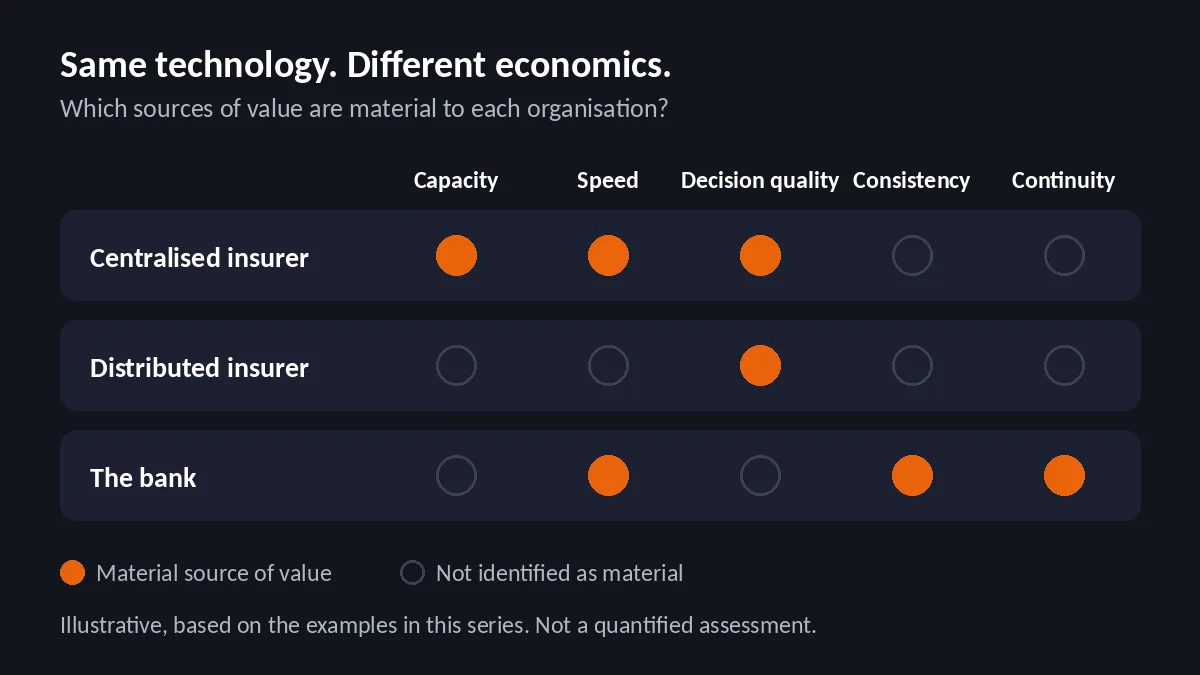
A few practical rules follow. Size the levers separately, avoid counting the same benefit twice, and be honest about which would actually appear in the financial results. Be most careful when the case rests on a single lever, because if that one does not move, nothing else will save it. And measure the value, not just the automation. For capacity, measure cost removed or hiring avoided. For speed, measure conversion, retention or the cost of delay. For decision quality, measure the financial outcome against a credible baseline. For consistency and continuity, look at rework, remediation and how dependent the process still is on a few individuals.
Alongside those, track how the agent is being used: the share of exceptions it now resolves without a person, the share it still escalates, and where supervisors override it. Those tell you whether the boundary is in the right place. On their own, they do not tell you whether the business is better off.
Know which lever pays for you before you start. It decides which process to begin with, what you measure, and how much risk you are really taking.
Which leaves an obvious question. If the value is this visible, why are so many exception queues still full? In my experience the answer is not that machines cannot work the cases. It is that nobody has decided what a machine is allowed to decide.
If you want to work out which of these levers applies to one of your own processes, message me.
Next in Past the Easy Stuff: the decisions we still refuse to automate. Why exception cases stay with people even when AI could work them, and why the real boundary is authority, not capability.
Past the Easy Stuff is Ajit Gupta's newsletter on LinkedIn. Subscribe on LinkedIn ↗