


Past the Easy Stuff · Part 2 of 7
On the same day recently I had back to back conversations with two tier 1 global insurers. Different companies, different markets, and almost the same opening question: we have done the easy stuff with AI, so where is the real money? My answer to both was the one from the last edition. The next value sits in straight through processing, in the claims, referrals and applications that still fall out of the rules and wait for a person.
Both agreed. Both could see the opportunity. And by the end of the day it was clear they would make completely different decisions about it, for reasons that had almost nothing to do with the technology.
The first insurer has consolidated much of its operations into large shared teams serving several markets, and it funds technology centrally. For them, extending straight through processing pays off on several fronts at once: fewer people needed to handle volume, faster and more consistent claims, better operational efficiency and quicker answers for customers. No single benefit carries the case, but together they make a strong one. Just as important, the cost of trying sits in one central budget. If an initiative underdelivers, the impact is absorbed across the whole business. The conversation moved quickly on to which process to start with.
The second insurer looks very different. It had already automated most of its routine processing, its operations are spread across many countries, and some of the work sits with external partners. There is labour that could be removed, but not many people are involved and the cost of that work is low. The only saving large enough to matter is in the outcome of its claims: how they are assessed, how accurately they are settled and how much leakage is avoided. And the cost of any AI initiative is borne by each country business unit. Every local leader is being asked to spend capital from their own budget on something that may or may not pay back. Their position was clear and, I think, rational: they want to do it, but they will not commit the capital unless the saving is close to guaranteed. Their real question was not where the money is. It was whether it is worth the investment at all. The challenge was not whether AI could do the work. It was proving that the work was worth doing.
Same industry, same capability, same day, and two different answers. What separated them was not appetite for AI. It was where the value sat and who had to pay to find out, and that set each one’s appetite for risk.
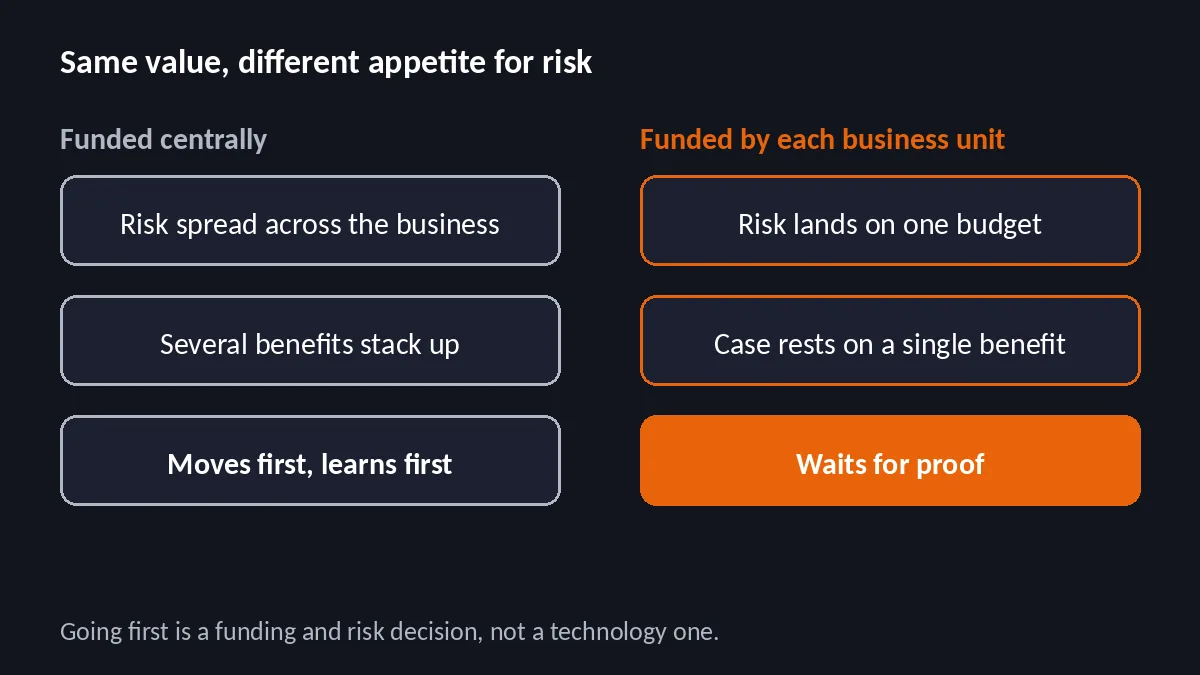
This is the part of the AI conversation that rarely gets said out loud. Time saved only becomes money saved if the cost can actually come out. If the same people stay in the same roles, using the same systems and the same approval steps, the organisation has created capacity, not savings. Capacity has value when there is growth to absorb it. Otherwise the business has paid for new technology, new oversight and new exception handling, and its costs have gone up. Better decisions can also create financial value without removing a single job, as the second insurer’s claims show, but that improvement has to be measurable too. An organisation that funds centrally, with several benefits stacking up, can carry that uncertainty. A business unit whose case rests on a single benefit, paid for from its own budget, usually cannot.
The same split shows up well beyond insurance. Banks with group-funded transformation programmes behave differently from those where each country or product line pays its own way. Telcos, healthcare groups and utilities face the same question. It is not a question of who is more innovative. It is a question of who can afford to be early. There is, however, a way to reduce the uncertainty. Start with one narrowly defined process, establish the current economics, and test whether AI improves the outcome. The business can also limit what the agent is authorised to do while that evidence builds, so the investment and the agent’s authority can both grow as confidence grows.
That is the real choice in front of most leadership teams. The value is real, but going first is a funding and risk decision, not a technology one. Moving early lets an organisation learn first and capture value before its competitors. Waiting can mean better tools, lower costs and lessons learnt by others. Both are legitimate. What matters is choosing deliberately, rather than letting enthusiasm or inertia make the decision for you. There is no point debating how to do this until you have decided which of the two you are, and whether your funding model lets you be the one you want.
For those who cannot carry the risk centrally, the answer is not to give up. It is to find a way to prove the value before committing the capital, which is the subject of the last edition in this series.
If your organisation funds change through its business units and you want to explore how to prove the value before committing the capital, message me.
Next in Past the Easy Stuff, Thursday 12 November: where the value actually comes from. Capacity, speed, decision quality, consistency and continuity, and why the lever that pays for one organisation may be worth very little to another.
Past the Easy Stuff is Ajit Gupta's newsletter on LinkedIn. Subscribe on LinkedIn ↗