


Past the Easy Stuff · Part 1 of 7
Almost every large organisation I speak to has done the easy stuff with AI.
Copilots draft emails and summarise documents. Chatbots answer routine questions. Search tools find the right policy clause in seconds rather than minutes. These are useful, and nobody should stop using them. But the savings are spread thinly across thousands of people, a few minutes at a time, and they rarely show up as a line a CFO can point to. They make individuals more productive without changing how the business actually runs.
The next set of value is somewhere else, and it is hiding in plain sight. In my view one of the biggest opportunities sits in straight through processing.
Most organisations automated their simple cases years ago, and that automation never needed AI. Rules are very good at the predictable. What rules cannot handle are the cases where the inputs vary too much, or the permutations are too wide to write down. Those cases fall out of the automated path and into an exception queue, where they wait for a person with the knowledge and authority to decide them. In some processes the fall out is small: buying motor or travel insurance rarely needs a human. In others it is large: credit card and loan applications, health insurance, claims, complex telco orders, patient referrals. Wherever it is large, the exception queue is where the cost, the delay and the customer frustration concentrate.
AI changes what is possible in that queue. When a case falls out of the rules, an exception agent picks it up and does the work a person does: gathering the missing information, checking the case against policy, weighing it the way an experienced reviewer would, and reaching a decision with the reasoning attached. Exceptions are the natural starting point, but they are not the only option. The same capability can also be used to improve the automated path itself, and the right balance between the two will differ by organisation. Either way the principle holds: extend straight through processing into the cases it could never reach, rather than replace automation that already works.
The clearest example I have seen comes from a tier 1 bank in Southeast Asia that we are working with. Its credit card applications follow the familiar pattern. Most go straight through. The ones that fall out of the rules land with a small group of experienced approvers whose judgement has been built over many years. The bank’s problem was not technology. That experience is scarce, it takes years to develop, and it does not scale. When volumes grow or people move on, the exception queue gets slower and decisions become less consistent.
So we built a digital twin of that judgement. In the pilot, an agent processes applications on the standard path. When one falls outside it, an exception agent picks it up, works the case using the bank’s policy, the evidence, the supervisory checks its experienced approvers apply and the bank’s past decisions on similar cases, and reaches a decision with its reasoning laid out. It is not a perfect replica of an experienced person. The tacit, intuitive part of their judgement is the hardest thing to reproduce, and learning from past decisions is not the same as copying them: the agent’s conclusions always remain bound by current policy and controls. But it captures much of what can be written down, and applies it to every case rather than only the ones that reach the right desk.
There is an important distinction here. The agent deciding that an application should be approved is not the same as the bank authorising the agent to approve it. The judgement is the agent’s. The authority to act on it belongs to the business, and so does the accountability. In the pilot, the exception agent resolves the cases that fall within the authority the bank has given it. The genuinely difficult ones are escalated to a supervisor, who receives the full case, the agent’s recommendation and the precedents behind it, and can accept or override it. For every application the agents complete, whether it went straight through or was resolved by the exception agent, the member of staff who triggered the agent remains accountable for the outcome and can undo the decision if it turns out to be wrong. Escalated cases are decided by the supervisor. That escalation line is a boundary the bank has chosen, not the source of the judgement. Because what the agent may act on is defined and enforced before anything happens, and every decision is recorded, the bank can widen that boundary for specific kinds of case as the evidence builds, and narrow it again if it needs to.
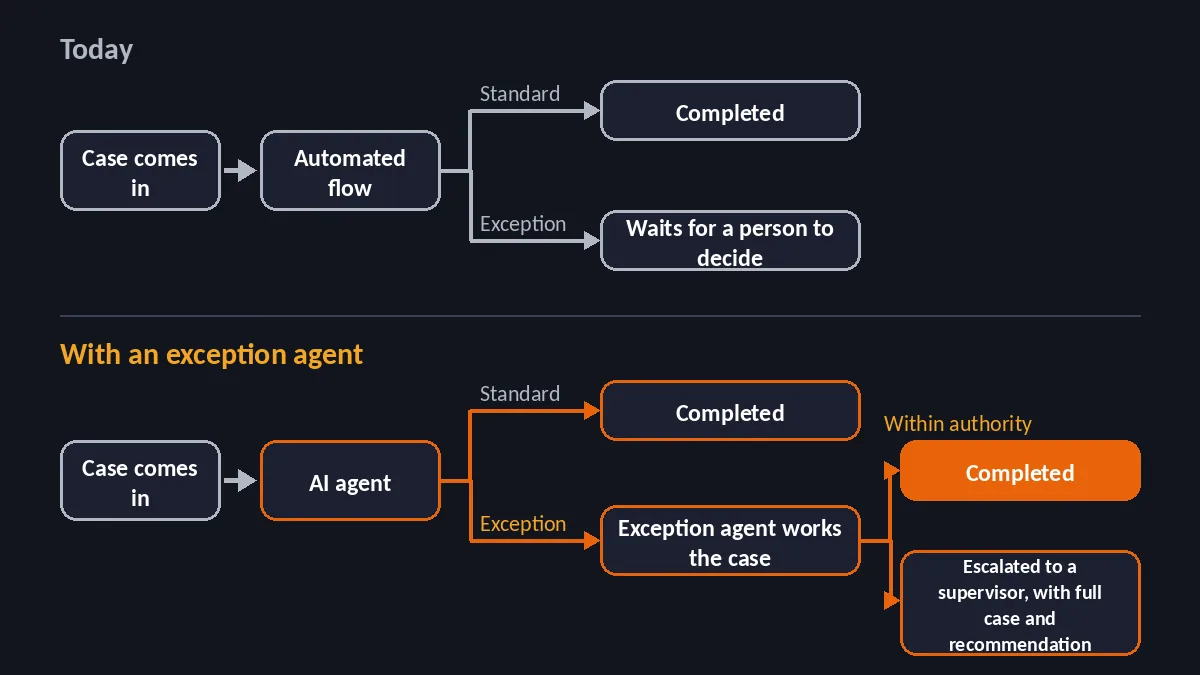
That is where the value comes from, and it comes in two forms.
- Some cases that used to need a person can, over time, be decided and acted on within the authority the bank has defined, and go straight through.
- The cases that still need a person should be quicker and more consistent to approve, because the investigation is done and a reasoned decision is already in front of the supervisor.
Knowledge that used to sit with a few experienced people becomes available on every case.
Those are the outcomes the pilot is designed to test, not results it has already measured, and their economics are different.
This is a pilot, not a production system (yet!). The hardest part, the instinct behind why a request for a large limit becomes a smaller one, is not fully captured yet. But the shape of the value is already clear, and it is not unique to banking. Any organisation with a large exception queue, a small number of people who really know how to clear it, and customers waiting on the other end has the same opportunity.
This is why I believe extending straight through processing is such a significant opportunity.
Years of automation have reduced the cost of processing predictable transactions, and much of the remaining effort is now concentrated in the cases that need investigation and judgement, the scarcest resource most businesses have. AI can now apply judgement to a wider range of those cases, using evidence, policy and precedent, within boundaries the business defines and enforces. And it builds on automation organisations have already invested in, rather than requiring them to start again.
That is the test I would apply to your own business. Where do cases fall out of your automated processes in volume? Who decides them, and how long do they wait? How much depends on a few people who really know how to decide them? If the answers point to a large exception queue in a process that matters, AI may now be able to take it on, and straight through processing is where you should be looking next.
Knowing where the value is, though, is not the same as justifying the investment. What is technically possible and what is economically worthwhile are different tests. In the next edition I will describe two global insurers I met on the same day, who see the same opportunity and are making very different decisions about it.
If you are exploring how AI could extend straight through processing in your organisation, message me, and I will show you how we are approaching it in a live demonstration.
Next in Past the Easy Stuff, Thursday 29 October: two tier 1 global insurers, met on the same day, both seeing the same opportunity in straight through processing. One will move quickly and one will not, and the reason has almost nothing to do with the technology. The next edition explains why going first with AI is a funding and risk decision, not a technology one.
Past the Easy Stuff is Ajit Gupta's newsletter on LinkedIn. Subscribe on LinkedIn ↗