

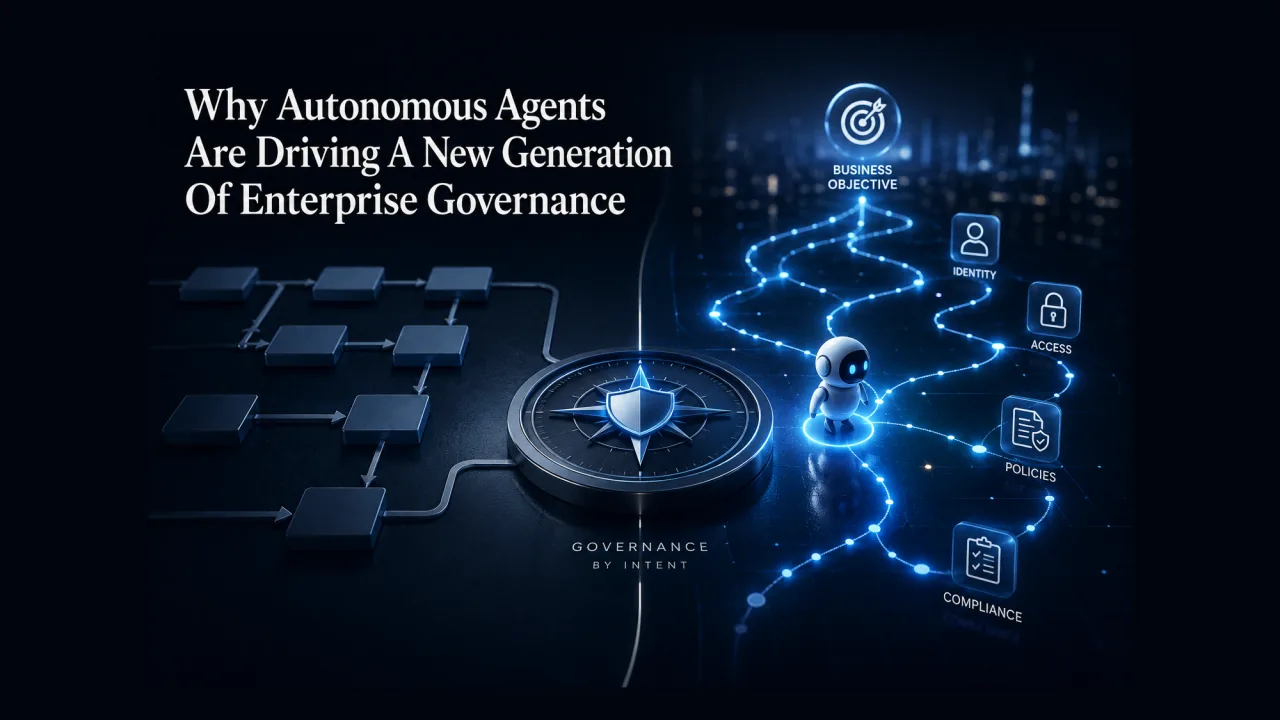
For decades, enterprise automation has followed a simple principle. If a business process could be mapped in advance, it could be automated. Workflow engines, business rules, approval systems, and orchestration platforms transformed how organisations operate by taking predictable work and executing it consistently at scale.
That model remains incredibly effective. But it has limits.
Many of the most valuable activities inside an enterprise cannot be fully mapped in advance. Fraud investigations, customer disputes, insurance claims, regulatory enquiries, software delivery, operational incidents, and complex customer service interactions all require adaptation to changing information and circumstances. Every situation is different. Every customer is different. Every investigation unfolds differently.
Traditional workflow systems struggle because every possible path must be anticipated before execution begins. As complexity increases, workflows become larger, harder to maintain, and increasingly fragile.
This is the problem autonomous agents are designed to solve.
Why Autonomy Matters
The opportunity presented by autonomous agents is often misunderstood. The goal is not simply to automate more tasks. The goal is to automate decision making in environments where the correct sequence of actions cannot be determined in advance.
Rather than following a predefined path, autonomous agents can gather information, evaluate options, choose tools, adapt to new information, and determine their own sequence of actions while pursuing a business objective.
This unlocks something enterprises have never had before. Software that can adapt. For many organisations, this represents the next major wave of productivity and operational scale.
The Hidden Cost Of Human Variability
There is another reason enterprises are interested in autonomy. Humans are adaptable, but they are also inconsistent.
Consider two customer service agents handling the same customer issue. One may be highly experienced. The other may be relatively new. One may understand the product deeply. The other may rely heavily on scripts. One may be having an excellent day. The other may be overloaded, distracted, or fatigued.
The result is that customers often receive different outcomes despite presenting the same problem.
Organisations invest heavily in training, coaching, quality assurance, supervision, and knowledge management to reduce this variability. Yet it remains a structural characteristic of human work.
Autonomous systems offer the possibility of combining adaptability with consistency. The same knowledge. The same operating standards. The same reasoning framework. Applied consistently across every interaction. That is one of the most compelling economic drivers behind enterprise autonomy.
The Governance Problem
Autonomy changes the nature of control. Traditional enterprise security and governance models were built around a different assumption. Software followed predefined logic. The primary question was therefore simple:
Who is allowed to do what?
Identity and access management, role based access control, attribute based access control, privileged access management, policy engines, and API gateways all evolved to answer that question. For traditional applications, that works well.
Autonomous agents introduce a different challenge. They choose their own actions. They determine their own path. They adapt during execution. As a result, an agent can be fully authorised and still make a decision that is inconsistent with the business objective it was supposed to achieve.
This creates a new category of risk.
Authorised But Wrong
Imagine a loan servicing agent authorised to assist customers experiencing financial difficulty. The agent has legitimate access to customer records, repayment schedules, servicing systems, and communication channels.
While assisting a customer, the agent modifies a repayment arrangement. The action falls within its permissions. The credentials are valid. The access is legitimate. Every security control returns "allow". Yet the decision is inappropriate for the customer's circumstances.
From a traditional access control perspective, nothing went wrong. From a business perspective, everything did. The agent was authorised. The outcome was wrong.
This is the challenge enterprises increasingly face as they move from automation to autonomy.
Why Existing Identity Controls Are Necessary But Not Sufficient
The identity industry is already evolving to support autonomous systems. Identity providers are introducing agent identities, non human identity management, dynamic authorisation, just in time access, and increasingly sophisticated policy driven controls.
These capabilities are important and will remain foundational. However, they primarily answer questions about identity, permissions, and access. They determine whether an agent may perform an action. They do not generally determine whether that action remains aligned to the business objective for which authority was delegated.
An agent can hold the correct identity, obtain legitimate access, satisfy every policy requirement, and still pursue an outcome that is inconsistent with the task it was supposed to complete.
As autonomy increases, enterprises increasingly need governance that complements
access control by evaluating purpose, intent, and execution context.
Why The Industry Is Converging
The interesting thing is that organisations across the industry are beginning to arrive at similar conclusions. Different vendors and practitioners approach the problem from different directions. Some focus on AI gateways. Some focus on guardrails. Others focus on evaluators, workflow approvals, observability platforms, human oversight mechanisms, or policy engines.
Each contributes something valuable. Yet all are ultimately attempting to answer the same question:
How do we know an autonomous system is still pursuing the objective it was authorised to perform?
That question sits above identity. Above permissions. Above APIs. Above logging. It requires understanding not only what an agent is doing, but why it is doing it. And increasingly, that is where the market appears to be converging.
From Access Governance To Intent Governance
For years, enterprise governance focused primarily on access. Can this user access this resource? Can this application call this API? Can this workload perform this operation?
Autonomous systems introduce a new requirement. Can this action be justified by the objective that was approved?
Answering that question requires governance models capable of understanding the business objective that was authorised, the task the agent is attempting to complete, the actions it plans to take, and whether those actions remain aligned to the approved objective.
In other words, governance must evolve from controlling access to governing intent.
The terminology may still change. Some organisations will call it runtime governance. Others may call it intent governance, purpose governance, or agent governance. The name matters less than the direction of travel. The convergence is already visible.
What Happens Next
This is not a debate about workflows versus agents. Both will coexist. Deterministic processes should continue to be handled by deterministic systems. Workflows remain the best answer when the path is known in advance.
The opportunity lies in the vast amount of enterprise work where the path cannot be fully defined beforehand. That is where autonomy creates value.
As organisations increasingly move this work from humans to software, governance must evolve alongside it.
The defining question of the next generation of enterprise systems may no longer be:
What is this system allowed to do?
Instead it becomes:
How do we know it is still doing what it was authorised to do?
The organisations that answer that question successfully will be the ones able to deploy autonomous systems safely, confidently, and at scale.
Writer’s Overview
Yuxiang Lin – Associate Director - R&D, Midships
Yuxiang leads solution architecture initiatives across Midships, driving innovation in identity and access management platforms. He focuses on bridging business objectives and technology constraints through forward-looking solution design and enterprise architecture excellence.
Short bio: Yuxiang is a solution leader specializing in IAM, authentication and authorization design, and enterprise architecture. He delivers scalable identity solutions that align business and technology goals across Asia, including Singapore, the Philippines, Indonesia, and Vietnam.
🔗 LinkedIn: Yuxiang Lin