

Anthropic just released ten finance agent templates. They cover the most expensive and most regulated parts of bank operations: KYC screening, month-end close, general ledger reconciliation, statement audit, valuation review, earnings review, and model building.
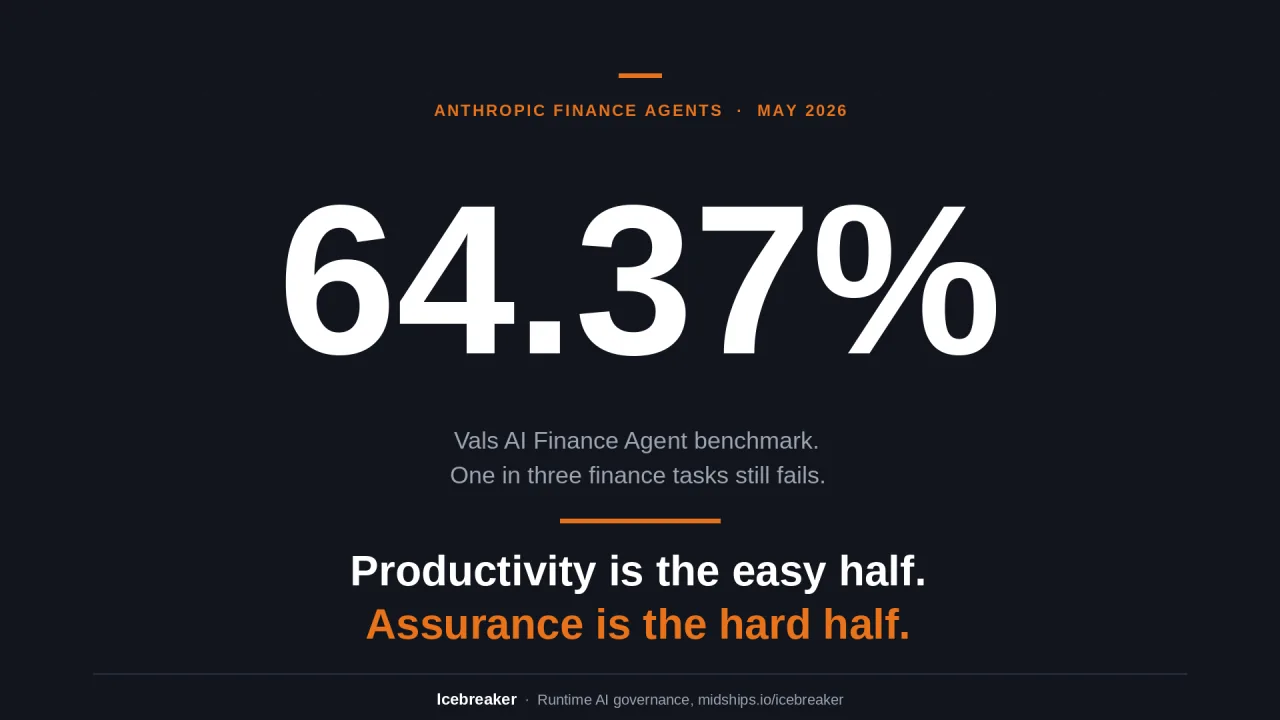
The published benchmark score is 64.37 percent on Vals AI's Finance Agent benchmark. Anthropic is clear that this is industry-leading. It is also the best on offer. Roughly one in three finance tasks still fails.
Read the announcement carefully on governance.
Anthropic does ship controls. Connectors carry governed data access. Managed Agents add per-tool permissions, managed credential vaults, and a full audit log in the Claude Console. Humans are expected to stay in the loop, reviewing and approving Claude's work before it goes to a client, gets filed, or is acted on.
That is access control, plus credential hygiene, plus forensic logging, plus manual review. Each of those answers a real question. None of them answers the question every CRO, CISO, and Head of Compliance is about to be asked.
How do we prove the agent did what it was authorised to do, and only that?
A governed connector lets the KYC agent read a customer record. It does not confirm the agent read that record for the declared KYC purpose, rather than to enrich a sales file. Per-tool permissions confirm the agent could call a tool. They do not confirm calling it served the declared business purpose of the session. An audit log records what happened. It is forensic, not preventative, and it does not survive a regulatory walkthrough when the question becomes "show me the evidence each action was on-purpose, across every session last quarter."
The subagent pattern compounds the problem. When an agent invokes subagents that invoke further subagents, the chain of intent fragments across hops. Whose business purpose governs the third call. The announcement does not say.
This is the governance gap.
We built Icebreaker to close it. A runtime layer that sits between the agent and the systems it touches, and asks a different question. Not "is this actor authorised", but "is this action aligned with the declared business purpose of this session".
System Purpose. Session Description. Intent Set with runtime monitoring. Attested at each layer. Every action provably tied back to a purpose a human approved before execution, not after.
The finance agent templates are a watershed moment for AI in regulated industries. They will accelerate adoption dramatically. They will also expose the governance gap faster than the market expected.
Productivity is the easy half of the problem. Assurance is the hard half.
#Icebreaker #Midships #AgenticAI #AIGovernance #FinancialServices
Writer’s Overview
Ajit Gupta – Co-Founder & CEO, Midships
Ajit leads Midships Group’s transition from a specialist identity consultancy to a portfolio of autonomous, AI-native business units. He focuses on long-term business relevance through platform thinking, customer outcomes, and scalable operating models.
Short bio: Ajit is a strategic founder with deep expertise in IAM, platform delivery, and AI services, driving Midships’ expansion across Asia, the Middle East, and beyond.