

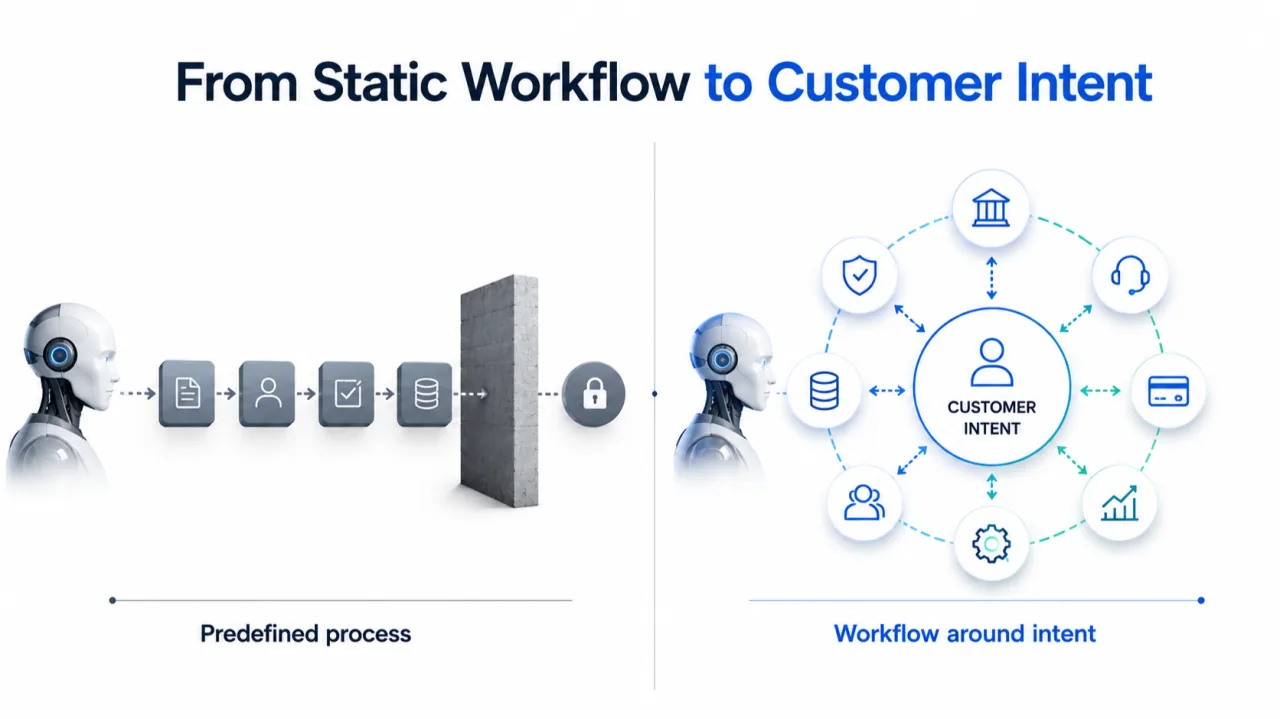
There is a version of the AI story that every enterprise has now heard.
Autonomous agents can understand what a customer is trying to achieve and orchestrate across systems to deliver it. Intent in. Outcome out.
It is being sold as a technology you buy and connect. Plug it into your existing products, channels and processes, and it works.
That is the misread. And it is a big one.
Customer intent driven workflow is not a tool that slots neatly into the organisation you already have. It is a demand that the organisation change shape. Most leadership teams think they are buying an upgrade. They are actually being asked to rethink how the enterprise is structured, owned and governed.
From my experiences engaging with large Tier 1 & 2 FS orgnanisations to date, the technology is the easy part. The distinction that made this land for me came from Nikki Gomez in a conversation this week. We were talking about AI enabling dynamic workflows, and he reframed it in a way I have not been able to put down.
Not dynamic workflow. Customer intent driven workflow.
That sounds like a small change of words. It is not. Dynamic workflow sounds like a technology upgrade, which is exactly how the market is treating it. Customer intent driven workflow points at something structural, and it exposes a problem most organisations have not solved.
Most organisations are currently built around products, domains, channels and functions. Those are the axes every large enterprise designs itself around, and for good reason. Products gave ownership. Domains gave expertise. Functions gave scale. Channels gave consistency.
The customer journey was designed to run along those axes because that is how the organisation was structured to deliver it.
But the customer does not think that way. The customer does not have a product. The customer has an intent. They want something resolved, approved, moved, explained, refunded, renewed or investigated. They do not care which of your domains owns which part of the answer.
Customer intent driven workflow flips the axis. You stop designing around products, domains and channels, and you start designing around the intent itself.
That does not mean product and domain teams disappear. It means their job changes.
They stop owning fixed customer journeys and start exposing governed capabilities that an autonomous system can safely orchestrate in response to what the customer is trying to achieve.
Ownership of the journey moves up to the outcome. Ownership of the capability stays with the team. That single change breaks the assumption most operating models are built on.
Here is the problem hiding inside the promise.
For decades, governance lived inside the process. The workflow was fixed, so the controls could be fixed with it. Approval sat at one step. The compliance check sat at another. The escalation rule sat somewhere else.
You governed the path because the path did not move; whereas Customer intent driven workflow removes the fixed path.
That is the entire point. The workflow assembles around the customer's intent, pulling in whichever enterprise capabilities the situation needs, in whatever order the situation demands. The moment you do that, you have dissolved the thing your governance was attached to.
Take a private bank client asking to move a significant sum to a new overseas account before end of day. That one intent may touch the account product, payments, fraud, financial crime, customer data, risk and compliance.
In the old model, those teams sat as sequential steps in a defined process, each with its own control. Now an autonomous system may resolve that intent by orchestrating those capabilities in real time.
So who owns the result?
The market is starting to reach this question. McKinsey and IBM have both moved the discussion from model accuracy to accountability when autonomous systems act. But accountability is not solved by naming a human owner and keeping a log.
That works when the process is fixed and you can point to the step. It does not work when the workflow assembled itself differently for every customer, crossed multiple domains no single owner controls, and made decisions no human saw in the moment.
When the workflow becomes dynamic, governance has to become dynamic with it. It has to operate at runtime. If capabilities are now orchestrated on demand rather than wired into a fixed journey, the controls cannot stay wired into the journey either. They have to travel with the intent.
The organisation has to be able to prove, after the fact, and to a regulator or a board, what the customer was trying to achieve, what authority they had granted, what the system inferred, what actions it took, what it blocked, modified or escalated, and why each action was permitted at the moment it happened.
That last point is the hard one. Not what the agent was allowed to do in principle. What it actually did in practice. And the proof that it never stepped outside the line.
I have now had this conversation with people who advise enterprises on AI governance for a living, and the join still is not being made. If it is not landing there, it is not landing in most boardrooms.
This is the real strategic question buried under the customer intent story. It is not whether AI can resolve customer intent across your organisational boundaries. It clearly can. It is whether you can prove it did so safely, every time, across boundaries no single part of your organisation owns.
The organisations that win the next decade will not be the ones with the most agents. They will be the ones that can let workflows assemble around customer intent and still stand behind every outcome with authority, control and evidence.
The intent story is everywhere now. The governance story is catching up. Almost nobody has joined the two.
That join is the whole game.
Writer’s Overview
Ajit Gupta – Co-Founder & CEO, Midships
Ajit leads Midships Group’s transition from a specialist identity consultancy to a portfolio of autonomous, AI-native business units. He focuses on long-term business relevance through platform thinking, customer outcomes, and scalable operating models.
Short bio: Ajit is a strategic founder with deep expertise in IAM, platform delivery, and AI services, driving Midships’ expansion across Asia, the Middle East, and beyond.